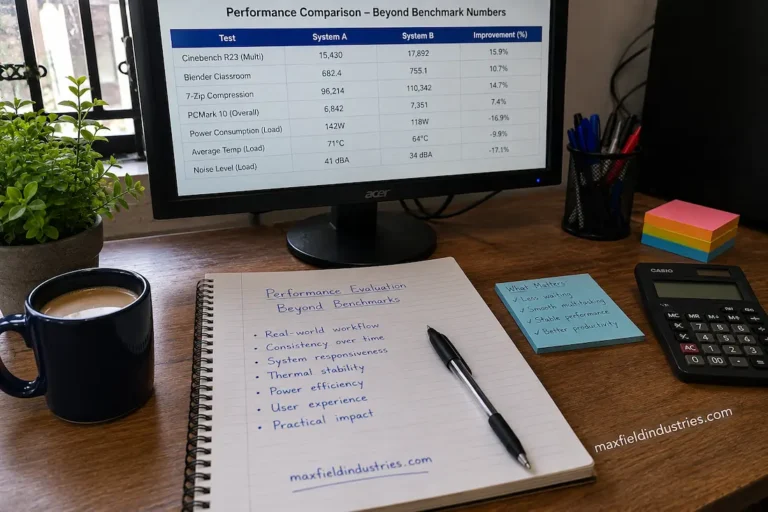
The word ‘performance’ almost always comes up in discussions of computer technology. Companies use it to promote new products and compare them using charts in reviews, while users often associate it with faster processors, more memory, or higher benchmark scores. Although the term is widely known, it is surprisingly difficult to define, as computers perform a vast array of functions, each with different system requirements.
This raises an important question: can we really apply the same concept of performance to compare two computers that handle different types of tasks? A computer used for document editing, online collaboration, and research is evaluated very differently from a workstation that runs technical simulations all day long. Despite their vastly different specialized capabilities, both perform their tasks excellently. To understand performance, therefore, we must first understand the purpose of the measurement, not the measurement itself.
Theoretical Capability Represents Possibility, Not Everyday Reality
Every hardware component has an inherent maximum capacity. A processor can complete a finite amount of work within a given timeframe; storage devices advertise their peak transfer speeds; and memory technology is defined by its operational characteristics. From a technical standpoint, this data is accurate and facilitates product comparisons.
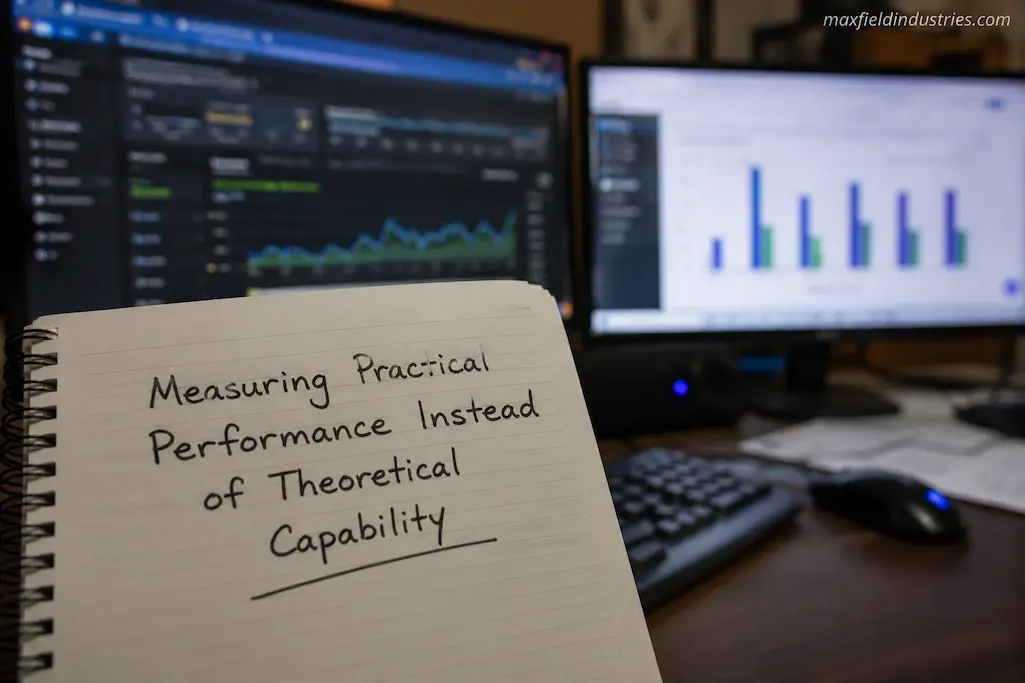
However, theoretical capacity refers to the performance hardware can achieve under ideal conditions, not its performance in real-world use.
Most computers do not achieve peak performance under perfect laboratory conditions. Instead, they contend with constantly changing workloads, software startup processes, background services, fluctuations in network communication, and frequent user switching between applications. In these situations, hardware does not always perform optimally, as it takes considerable time to adapt to changing demands.
Understanding this distinction can help you avoid unrealistic expectations. Performance limits are defined by theoretical capabilities, whereas actual performance reflects the extent to which those capabilities can be utilized in day-to-day life.
Completing Work Efficiently Is More Meaningful Than Reaching Maximum Speed
People generally do not use computers solely to experience peak performance; the primary goal is almost always to accomplish meaningful work.
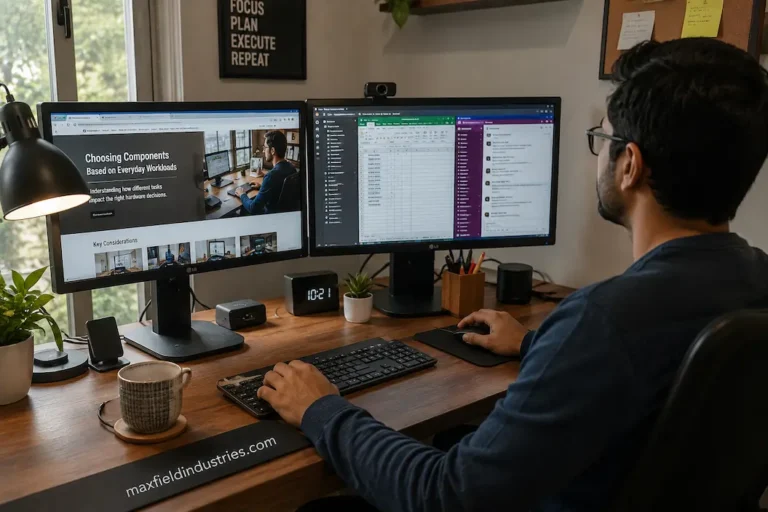
Writing reports, analyzing data, developing software, editing photos, organizing research, participating in online meetings, and managing business operations are all complete workflows, not isolated technical tasks. Success is measured not by how often the computer runs at full capacity, but by the quality of the work completed.
If a workflow centers on conversation, organization, or decision-making, even a system with powerful processors may offer little added value. Conversely, a computer with relatively modest specifications can feel highly efficient if it supports every step of the workflow without unnecessary interruptions.
From this perspective, the focus shifts from raw performance to the overall quality of the computing experience.
Practical Performance Emerges From Many Small Interactions
Daily work consists of many small tasks that often go unnoticed.
People spend their days opening reference materials to create presentations, switching between browser tabs while researching, reviewing countless documents, checking messages while analyzing data, and toggling between applications. Although these actions may seem simple in isolation, collectively they determine the computer’s responsiveness over extended periods of use. Over time, the value of improving response speed increases because these actions occur so frequently. This is particularly important for small, cumulative changes.
Therefore, actual performance improvements stem from gains in efficiency. The focus is not on a single impressive feature, but rather on demonstrating how well the system supports daily tasks without disrupting the user’s concentration or workflow.
Measuring Daily Productivity Requires a Different Perspective
In the past, computers were often compared based on their speed in executing specific technical tasks. While these metrics are useful, they do not always reflect whether people are actually more productive throughout the day.
Consider two different evaluation methods.
One method measures how quickly a processor performs a series of complex calculations. The other observes how easily a professional handles a full day of communication, analysis, revision, collaboration, and document management.
There are two ways to measure success, yet they yield drastically different results.
The first method tests hardware performance in a controlled environment. The second focuses on how technology helps people perform tasks in various real-world situations. Although these two methods are not interchangeable, understanding the differences helps explain why rapid technological advancement does not always lead to a leap forward in daily productivity.
Performance Should Include Stability, Not Just Speed
A computer that works well for a short time but becomes unstable after prolonged use differs significantly from one that remains stable throughout the day.
Stability is crucial in many respects and directly impacts success.
If an application remains responsive after hours of continuous use, performs stably under sustained heavy loads, and allows multiple running programs to interact predictably, users can focus on the work itself rather than the computer.
Viewing performance from this broader perspective clarifies why those responsible for critical systems often prioritize stability over maximum throughput. Reliable operation reduces interruptions and uncertainty, contributing to consistently high productivity. From this perspective, performance is not just about speed; it is a comprehensive reflection of functionality and reliability.
Looking at Performance Through More Than One Lens
Because computers perform many different roles, evaluating them through a single measurement inevitably overlooks important characteristics.
A more balanced assessment considers several complementary observations.
| Perspective | What It Helps Reveal |
|---|---|
| Task completion | How effectively meaningful work reaches completion |
| Responsiveness | How smoothly the system reacts during normal interaction |
| Operational consistency | Whether behavior remains predictable over extended use |
| Resource efficiency | How effectively available hardware supports the workload |
| Long-term usability | Whether performance remains practical as computing demands evolve |
Each perspective contributes to the overall picture. None is intended to replace another because practical performance emerges from their combined influence rather than any single measurement.
The Best Systems Often Go Unnoticed
An interesting characteristic of well-designed computers is that users often stop attending to them.
Applications respond when expected, projects progress without unnecessary delays, background activity rarely interferes with active work, and the operating environment remains predictable throughout the day. Users shift their attention away from managing the computer and back toward the work they are performing.
This may seem like an ordinary outcome, yet it represents one of the strongest indicators of practical performance. Hardware has succeeded not because it constantly demonstrates its theoretical capability, but because it quietly supports meaningful activity without becoming an obstacle.
That difference lies at the heart of practical performance. Rather than asking how powerful a computer could be under perfect conditions, it asks how effectively the system contributes to everyday work when real conditions are far less predictable.
Practical Performance Changes as Computing Habits Change
One aspect of performance that receives relatively little attention is its ability to evolve alongside the user. A computer purchased several years ago may have been intended primarily for web browsing, email, and document preparation. Over time, that same system might become responsible for managing cloud-based projects, editing large media files, attending virtual meetings, or running increasingly sophisticated applications.
These changes alter the meaning of acceptable performance.
A system that once appeared highly responsive may gradually feel less capable, not because the hardware has deteriorated, but because the nature of the work has changed. Measuring practical performance therefore requires considering the relationship between the computer and its current responsibilities rather than comparing today’s experience with expectations established years earlier.
Looking at performance through this evolving perspective helps explain why identical hardware may remain perfectly adequate for one user while becoming increasingly restrictive for another.
Performance Is Created by Cooperation, Not Individual Excellence
Modern computers operate as coordinated systems in which multiple components exchange information continuously. Processing hardware, memory, storage, graphics resources, networking equipment, firmware, and software all contribute to completing even relatively simple tasks. As a result, practical performance reflects how effectively these parts cooperate rather than how powerful one individual component appears in isolation.
Imagine a project involving large documents, cloud synchronization, web-based research, and communication software running simultaneously. The experience depends on efficient interaction between many subsystems rather than exceptional capability in only one area. If one resource consistently delays another, the overall workflow slows regardless of how impressive the remaining hardware may be.
For this reason, experienced system evaluators often focus on balance. A computer whose resources complement one another generally delivers a smoother and more predictable experience than one designed around a single exceptionally capable component.
Measuring Performance Requires Context
Performance figures have little meaning unless you understand the conditions under which you observed them. A result obtained while processing one type of workload cannot automatically be applied to every other situation because applications interact with hardware differently. Some rely heavily on sustained computation, while others spend much of their time retrieving information, communicating across networks, or waiting for user input.
Context therefore gives performance its meaning.
When evaluating a system, questions about the workload become just as important as questions about the hardware itself. How long do tasks typically last? Are several applications active at the same time? Does the computer remain busy throughout the day or operate intermittently? Answers to these questions help explain why two systems with comparable capabilities may deliver noticeably different experiences under different circumstances.
Removing performance from its context often leads to conclusions that appear logical but fail to reflect practical use.
Small Improvements Can Produce Significant Long-Term Benefits
Performance discussions frequently emphasize dramatic gains because they are easier to demonstrate and easier to market. Everyday computing follows a different pattern. Productivity often improves through the accumulation of many small efficiencies rather than one remarkable increase in processing speed.
A slightly shorter application launch, smoother movement between active programs, more consistent file access, or fewer interruptions during prolonged work sessions may appear insignificant when viewed individually. Over weeks and months, however, these incremental improvements reduce unnecessary waiting and allow work to progress with fewer disruptions.
This gradual accumulation explains why a single impressive statistic cannot always summarize practical performance. Its value often becomes apparent only after observing how comfortably the system supports ordinary work over extended periods.
Evaluating Capability and Practical Performance Together
Neither theoretical capability nor practical performance should replace the other. They answer different questions and become most valuable when interpreted together.
| Evaluation Focus | Primary Question Answered |
|---|---|
| Theoretical capability | What is the highest level of performance the hardware can achieve under appropriate conditions? |
| Practical performance | How effectively does the computer support everyday work across changing situations? |
| System consistency | Does performance remain dependable throughout prolonged use? |
| Workflow efficiency | Are meaningful tasks completed with fewer interruptions and delays? |
| Long-term adaptability | Can the system continue supporting evolving computing needs without unnecessary limitations? |
Considering these perspectives together produces a more balanced understanding than relying on either theoretical measurements or everyday observations alone.
Practical Evaluation Encourages Better Decisions
When people focus exclusively on a computer’s most powerful features, they sometimes base their purchasing decisions on raw numbers. While objective measurements remain important, they do not always reflect which system will outperform the rest after months or even years of daily use.
During actual evaluations, people ask different questions. Instead of asking which product offers the most features, they focus on the system’s overall reliability, responsiveness, flexibility, and balance. These characteristics may not always generate the most exciting marketing hype, but they often determine whether a technology remains useful throughout its entire lifespan.
This more holistic perspective aids not only in product purchases but also in planning upgrades, developing maintenance schedules, and managing systems over the long term. This approach is because it ensures that technology evaluations align with actual computing goals, rather than focusing solely on individual performance metrics.
Performance Is Ultimately About Supporting Work
Technology exists to help people accomplish important tasks. Every processor cycle, memory operation, storage request, and network exchange is part of a larger plan; it is not an isolated event. From this perspective, the criteria for measuring success shift accordingly.
Hardware is no longer praised solely for its impressive performance. Instead, the focus shifts to how these features enhance the daily computing experience. A reliable system enables users to concentrate on tasks—such as problem-solving, content creation, learning new skills, or fulfilling responsibilities—without being distracted by frustrating technical issues. While technical metrics remain important when assessing performance from this practical perspective, they are no longer the sole determinant of success.
Conclusion
Theoretical capabilities tell you what a computer *should* be able to do, but real-world performance demonstrates how those capabilities help you execute tasks in practice. Top-tier specifications reveal a computer’s technological limits, yet the overall computing experience depends on resource responsiveness, stability, collaborative efficiency, smooth workflows, and the computer’s ability to adapt to changing needs over time.
Viewing matters from both perspectives enables you to make more informed decisions and set more realistic goals. A real-world evaluation goes beyond mere peak performance figures; it examines how effectively the technology supports meaningful activities throughout weeks, months, and even years of daily use. Ultimately, the most practical computers are often not the most powerful on paper, but rather those that help people work confidently, efficiently, and with fewer distractions.