Modern electronic products rarely stop working because a single component suddenly “ages.” The first signs of aging sometimes appear years before the product fails. For instance, desktop computers might stutter under heavy loads, laptop batteries may lose their original charge capacity, and storage devices might show a gradual decline in write performance. These changes often result from natural aging, even though many stem from decisions made long before the product reaches the consumer.
Reliability begins with design.
The design of every circuit board, cooling unit, connector, and structural component is based on assumptions about how the product will be used throughout its lifespan. Engineers look at how heat moves through the casing, how electrical signals move between parts, how materials hold up to thousands of cycles of expansion and contraction, and how mechanical parts hold up to repeated stress. Their goal is not to create technology that works for only a few weeks, but to design systems that remain stable after years of frequent use.
This perspective helps explain why products with identical specifications can sometimes have vastly different long-term reputations. Processor performance and storage capacity are easy to compare, but reliability depends on dozens of technical decisions that are often difficult to capture in specifications.
Reliability Is Designed Long Before Manufacturing Begins
Before a prototype is built, engineers establish design goals that go beyond mere performance. They define how the hardware should function after prolonged use, how it should perform in constantly changing environments, and what constitutes an acceptable level of performance degradation over its intended lifespan.
These aspects influence virtually every stage of development. For example, the layout of heat-generating components affects internal temperatures, which in turn influences the lifespan of adjacent electronic components. Selecting materials with the appropriate thermal expansion properties helps reduce mechanical stresses caused by repeated heating and cooling cycles. The shape of the printed circuit board can even influence how mechanical forces are distributed when the device is moved or transported.
Reliability is the result of multiple interconnected decisions, not something determined by a single design feature.
Instead of asking, “How fast can this hardware operate?” engineers often ask a different question:
How consistently can this hardware perform under expected conditions over many years?
That distinction separates products optimized for sustained operation from those designed primarily to achieve impressive benchmark results.
Heat Is One of the Most Persistent Challenges in Hardware Engineering
Electronic components generate heat whenever electrical energy is converted into useful work. Although modern processors and graphics hardware have become increasingly efficient, higher computational capability has also increased the amount of heat concentrated within relatively small physical spaces.
Managing this heat is one of the most important factors affecting long-term reliability.
High operating temperatures accelerate several aging processes inside electronic components. Semiconductor materials experience greater electrical stress, capacitors gradually lose effectiveness, solder joints undergo repeated expansion and contraction, and cooling systems themselves experience additional wear.
Engineers therefore treat thermal management as a system-wide responsibility rather than the task of a single cooling fan.
Effective thermal design typically considers:
| Design Element | Contribution to Long-Term Reliability |
|---|---|
| Heat sink efficiency | Removes heat from critical components |
| Airflow pathways | Prevent localized heat buildup |
| Vent placement | Improves natural heat dissipation |
| Thermal interface materials | Enhances heat transfer between surfaces |
| Fan control algorithms | Balance cooling performance with mechanical wear |
Each element contributes to maintaining stable operating temperatures during prolonged workloads rather than simply lowering peak temperature measurements.
Material Selection Shapes Product Lifespan
When comparing hardware, attention often focuses on processors, graphics cards, or storage devices. Far less visible are the materials used to support these components throughout years of operation.
Material selection affects far more than appearance.
A computer enclosure must resist deformation while protecting internal hardware from vibration. Heat spreaders require materials with high thermal conductivity. Connectors experience thousands of insertion cycles, demanding surfaces that resist corrosion and mechanical wear. Flexible cables inside laptops must tolerate repeated opening and closing without developing electrical faults.
Different materials offer different advantages.
| Material Characteristic | Why Engineers Consider It |
|---|---|
| Thermal conductivity | Controls heat movement between components |
| Mechanical strength | Prevents structural fatigue |
| Corrosion resistance | Improves long-term electrical reliability |
| Dimensional stability | Maintains alignment despite temperature changes |
| Fatigue resistance | Withstands repeated mechanical stress |
These choices rarely appear in product advertisements, yet they strongly influence how hardware behaves after years of daily use.
Small Design Decisions Can Have Enormous Long-Term Consequences
Reliability often hinges on seemingly insignificant details.
Even moving a connector just a few millimeters further away from a major heat source can reduce long-term thermal stress. Reinforcing mounting points minimizes mechanical flexing. Increasing the thickness of a printed circuit board improves its ability to withstand vibrations during transport.
These adjustments may not significantly alter benchmark scores.
Yet, collectively, they determine a product’s stability after thousands of hours of operation.
It is this cumulative effect that drives experienced hardware engineers to devote considerable time to analyzing prototype layouts before mass production. Small improvements made early in the development process can often prevent reliability issues that might otherwise arise years later.
Consequently, engineering reliability depends less on a single groundbreaking idea and more on eliminating hundreds of minor pitfalls before they escalate into genuine problems.
Performance and Reliability Sometimes Compete With Each Other
Consumers naturally expect hardware to become both faster and more reliable with each iteration. In practice, achieving both goals simultaneously often requires a compromise.
Designers can enhance computer performance by increasing processor speeds, raising power limits, or shrinking manufacturing dimensions. However, these improvements also lead to higher heat density, more complex circuitry, or stricter manufacturing precision requirements.
Design teams must strike a balance between these competing demands. Running a processor at higher power levels might improve short-term test performance, for instance, but it also places greater demands on the cooling system’s heat dissipation capabilities and the surrounding components. Consequently, engineers must determine operational limits to ensure acceptable reliability throughout the product’s expected lifespan.
This need for balance is present in many aspects of hardware design.
Running cooling fans at full speed continuously might slightly lower component temperatures, but it can also lead to accelerated bearing wear and increased noise. Intelligent fan controllers automatically adjust fan speed based on workload, thereby extending mechanical lifespan while maintaining effective heat dissipation.
Reliability sometimes depends on striking a balance, rather than simply optimizing every measurable parameter.
The Internal Layout Matters More Than Most Users Realize
Two computers with similar external dimensions can feature drastically different internal architectures.
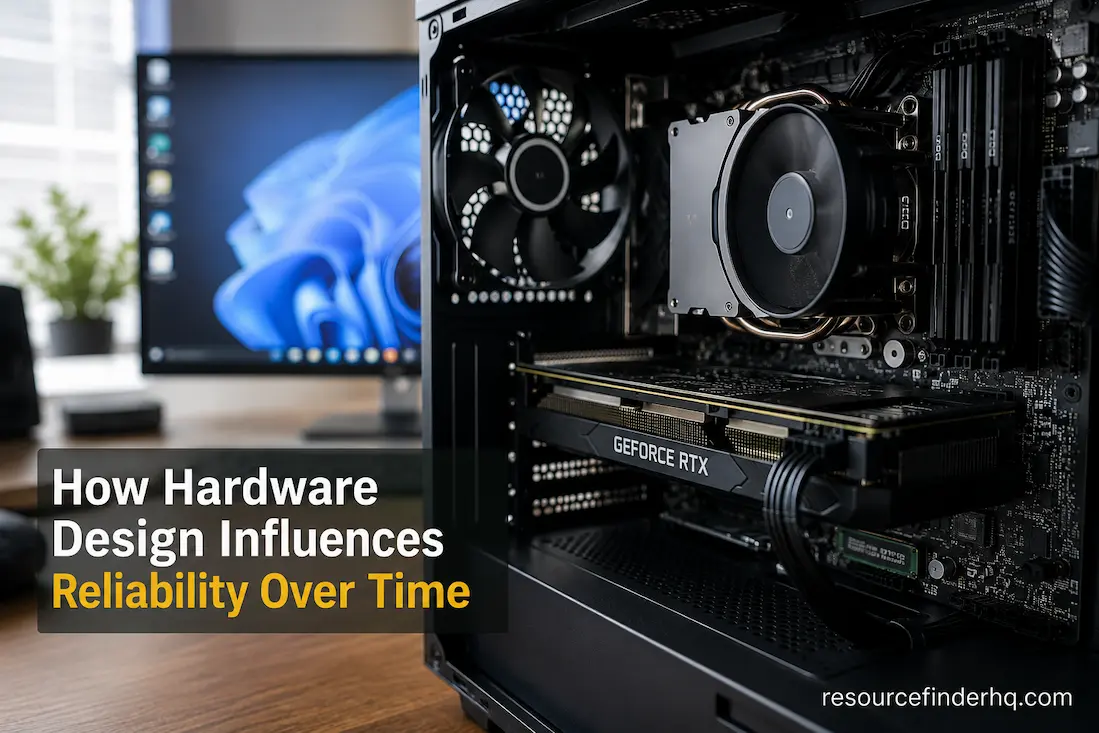
Some systems isolate hot components to improve airflow, while others keep storage devices away from primary heat sources. Cable routing can be designed to minimize airflow obstruction, and structural supports are typically positioned where mechanical stress is likely to concentrate.
These considerations go far beyond mere ease of assembly.
A poor internal layout can lead to localized overheating, where specific areas consistently run hotter than other parts of the chassis. Even if the system functions normally, components in these areas will wear out faster over time.
A well-designed layout distributes the device’s thermal load more evenly.
Engineers typically use thermal simulations to evaluate the internal layout before building actual prototypes. These models help identify areas that ultimately compromise reliability, such as overheating, insufficient airflow, or concentrated mechanical stress.
Although most users cannot see it, the internal architecture is one of the most important factors determining the lifespan and durability of hardware.
Reliability Testing Extends Beyond Normal Operating Conditions
Hardware intended for long-term use is usually tested under a variety of circumstances.
Manufacturers perform extensive validation procedures that expose prototypes to conditions significantly more demanding than typical everyday use. The objective is not to predict every possible failure but to identify weaknesses before products enter mass production.
Common evaluation methods include:
- Continuous operation under sustained computational loads.
- Repeated heating and cooling cycles.
- Mechanical vibration testing.
- Connector insertion and removal cycles.
- Environmental humidity exposure.
- Power fluctuation testing.
Each test focuses on a different aspect of long-term durability.
Rather than proving that hardware will never fail, these evaluations help engineers understand how designs respond to stresses likely to occur throughout years of operation.
Reliability Is Often Measured in Consistency Rather Than Longevity
When people discuss reliable hardware, the conversation usually centers on lifespan—how many years a device will continue working before it fails. While longevity is certainly important, engineers often evaluate reliability using a broader perspective.
A reliable system is expected to perform consistently throughout its operational life, not simply remain functional.
For example, a workstation that completes computational tasks with predictable performance after several years of daily use demonstrates a different level of reliability than one that frequently experiences thermal throttling, intermittent crashes, or unexpected shutdowns despite still being technically operational.
Consistency includes characteristics such as:
- Stable operating temperatures during prolonged workloads.
- Predictable electrical behavior under changing power demands.
- Reliable communication between interconnected components.
- Mechanical integrity after repeated handling.
- Minimal performance variation under similar operating conditions.
Viewed this way, reliability becomes less about avoiding failure entirely and more about maintaining dependable behavior throughout the product’s intended service life.
The Environment Continues Shaping Hardware After It Leaves the Factory
Hardware design establishes the foundation for reliability, but the surrounding environment continues influencing that reliability every day.
Temperature, humidity, airborne dust, vibration, and power quality all interact with the design decisions made during development.
Consider two identical desktop computers installed in different locations.
One operates in a climate-controlled office with regular maintenance and stable electrical power. The other runs continuously inside a dusty workshop where temperatures fluctuate significantly throughout the year.
Although both systems share identical hardware, their operating environments expose them to very different forms of stress.
Some environmental influences include:
| Environmental Factor | Potential Long-Term Effect |
|---|---|
| Elevated ambient temperatures | Increased thermal stress on electronic components |
| Dust accumulation | Restricted airflow and reduced cooling efficiency |
| Frequent power interruptions | Greater electrical stress during repeated startup cycles |
| High humidity | Increased likelihood of corrosion over extended periods |
| Continuous vibration | Accelerated wear on connectors and mechanical assemblies |
This relationship explains why manufacturers often specify recommended operating conditions alongside hardware specifications. Those recommendations are not merely guidelines—they reflect the environments in which the product was designed to achieve its expected reliability.
Why Simplicity Can Improve Reliability
As computer hardware becomes more capable, it also becomes more complex.
Additional sensors, higher-speed communication pathways, more sophisticated power management systems, and increasingly compact layouts enable impressive performance gains. At the same time, every additional subsystem introduces new interactions that engineers must understand and validate.
Complexity itself is not a weakness, but unnecessary complexity can increase the number of conditions that must function correctly over time.
This is one reason why many industrial systems emphasize simplicity wherever practical.
Examples include:
- Reducing the number of moving parts.
- Shortening signal paths on circuit boards.
- Designing modular assemblies that simplify maintenance.
- Minimizing unnecessary mechanical joints.
- Standardizing connector layouts.
Simpler designs often provide fewer opportunities for cumulative wear or unexpected interaction between components.
Rather than pursuing complexity for its own sake, engineers aim for designs that achieve their objectives with the fewest unnecessary compromises.
Reliability Is Shared Across the Entire System
No hardware component operates in complete isolation.
A power supply affects the stability of every connected device. Cooling efficiency influences processor behavior, graphics performance, storage temperatures, and even memory reliability. Likewise, motherboard design governs communication pathways between nearly every major subsystem.
Because of this interdependence, reliability should be viewed as a characteristic of the complete system rather than any individual component.
A premium processor installed alongside inadequate cooling cannot consistently demonstrate its intended performance. Similarly, high-quality storage devices depend upon stable power delivery and reliable controller communication to maintain data integrity.
The following illustration highlights this relationship.
| System Area | Depends Upon |
|---|---|
| Processor stability | Cooling, motherboard power delivery, firmware |
| Memory reliability | Processor memory controller, motherboard layout |
| Storage integrity | Stable power, controller design, operating temperature |
| Graphics performance | Cooling, power supply, motherboard bandwidth |
| Overall system reliability | The combined performance of every subsystem |
This interconnected nature explains why professional workstation builders evaluate complete platform designs rather than selecting individual components solely on their standalone specifications.
Why Reliability Improvements Are Sometimes Invisible
Performance improvements are easy to demonstrate. A benchmark can show shorter rendering times, higher frame rates, or faster application launches within minutes.
Reliability improvements are different.
Many of the engineering decisions that enhance durability produce no immediately noticeable difference during normal operation.
A redesigned heat sink may reduce thermal cycling over several years without affecting benchmark results. Stronger connector reinforcement may prevent future failures while appearing identical to the previous design. Improved voltage regulation may increase long-term stability without changing application performance in any measurable way.
These refinements often go unnoticed precisely because they are successful.
Expected reliability is one of the most valuable outcomes of thoughtful engineering.
Designing for Maintenance Is Also Part of Reliability
Reliability does not end once hardware enters service.
Many systems are intentionally designed so routine maintenance can be performed without placing unnecessary stress on surrounding components.
Examples include:
- Easily removable dust filters.
- Clearly accessible cooling assemblies.
- Replaceable storage devices.
- Standardized connector layouts.
- Service documentation that supports accurate repairs.
These design considerations acknowledge an important reality: even well-engineered hardware benefits from periodic maintenance.
Products that are difficult to clean, inspect, or repair often experience reduced practical lifespan because routine servicing becomes less likely or more complicated.
From an engineering perspective, maintainability and reliability frequently support one another.
A Different Way to Evaluate Hardware Quality
Consumers often compare products by asking which device is faster, newer, or offers the highest specifications.
A more revealing question is:
How well is this hardware likely to perform after years of regular use?
Answering that question requires looking beyond specification sheets.
It involves considering:
- The quality of thermal engineering.
- Mechanical construction.
- Material selection.
- Power delivery design.
- Validation testing.
- Serviceability.
- Overall platform balance.
None of these characteristics can be summarized by a single benchmark score, yet together they shape the long-term experience of owning and operating the hardware.
Conclusion
Reliable hardware rarely owes its success solely to a single superior component or outstanding feature. Rather, it is the result of hundreds of technological choices working in concert to reduce load, manage temperatures, maintain electrical stability, and ensure structural integrity over years of use.
Performance metrics may garner the most attention, but reliability is a different matter entirely; it is proven only over time, not merely through testing. Products renowned for their reliability are typically those whose designers considered not only how the hardware would function at launch, but also how it would remain stable after thousands of hours of real-world use.
This approach enables a more nuanced evaluation of technology. We no longer judge technology solely by its advertised features; instead, we can pinpoint the design decisions that subtly influence those attributes, thereby determining stability long after the initial excitement of the purchase has faded.