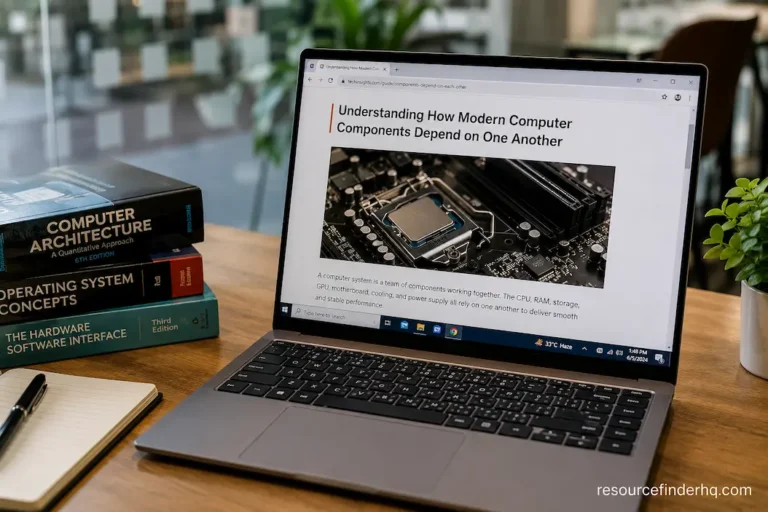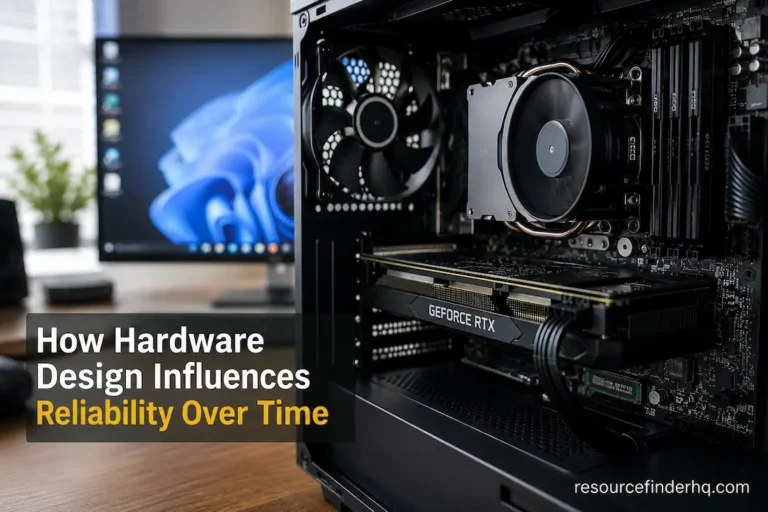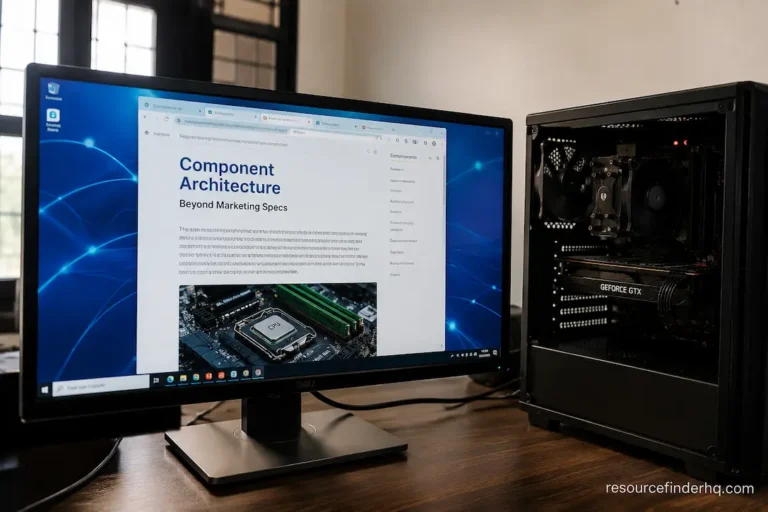
Computer instability is rarely caused by a defect in a single component. More often, instability arises because multiple system components operate simultaneously under conditions for which they were not designed. A processor can handle heavy workloads, but its performance depends on stable memory response, smooth data transfer from storage devices without noticeable lag, a stable power supply, and the cooling system’s ability to prevent overheating. If any of these links fail, the consequences can be severe.
That is why experienced engineers often speak of a computer as a balanced system rather than a collection of independent components. Balancing does not mean that all components share the same functionality or cost; rather, it represents the extent to which each component complements the others, allowing the platform to maintain predictable performance under varying workloads. Stability is often the most visible manifestation of this balance. Users have fewer interruptions, programs run more smoothly, and the operating system doesn’t have to spend as much time fixing problems that could have been avoided if hardware resources had been better coordinated.
Stability Is Built Gradually, Not Added Later
Many discussions about stability center on debugging after problems have already occurred. They analyze system freezes, sudden restarts, program crashes, and intermittent hardware issues individually, focusing on the most obvious symptoms. Technical design takes a different approach.
Designers do not investigate why the system is unstable; instead, they consider how to prevent such instability from the very beginning of the hardware design process. This fundamentally shifts the focus of the discussion. The emphasis is no longer on individual failures, but on creating an environment where all critical subsystems can function within acceptable limits.
This philosophy has significantly influenced countless design decisions. Power systems are designed with reasonable operational margins rather than being constantly pushed to their limits. Cooling systems are designed to meet continuous cooling needs, not just short-term peak loads. Memory support is tested across multiple configurations to minimize compatibility issues. Communication channels are set up to ensure that frequently used components do not introduce unnecessary latency for other components.
From this perspective, stability is not an optional feature of the final product, but rather the result of numerous interconnected technical decisions that mitigate the risk of problems from the outset.
Balance is about Interrelationships, Not Absolute Performance Parity
The term ‘balance’ can easily be misleading, as it suggests that every component must deliver the same level of performance. However, hardware balance refers to compatibility, not absolute performance parity. Consider, for example, an architectural design workstation. Since visualization is crucial to the expected workload, the graphics processing unit (GPU) may account for a significant portion of the system’s overall performance. Yet, such a scenario does not necessarily mean the computer’s performance is unbalanced. If the processor, memory, storage system, cooling system, and power supply are carefully selected to efficiently support the graphics hardware, the platform can maintain a reasonable balance, even with performance disparities between components. Problems arise when a system component regularly requires resources that exceed the actual capacity of the surrounding hardware.
For instance, if the interface limits available bandwidth, even storage devices with extremely high transfer rates cannot sustain such speeds. If programs rarely utilize large amounts of memory, that memory is virtually useless; conversely, if memory access becomes the bottleneck, even a very powerful CPU may spend a significant amount of time waiting for data.
In both cases, system stability is not guaranteed, and efficiency suffers because the system operates with unnecessary performance imbalances.
Hardware Rarely Operates at Peak Efficiency
Specifications define individual components, yet a computer operates within a constantly changing environment.
Background services unexpectedly initiate new tasks. Security software runs scheduled scans. Storage devices process incoming requests, and network activity fluctuates over time. User applications switch between light interaction and heavy computation, depending on the task at hand.
These shifting environments place constant demands on hardware coordination.
A balanced system can absorb these changes without significant disruption, as it distributes available resources across the platform rather than concentrating them in a single subsystem. Components possess ample operational headroom to handle unexpected workload increases, ensuring that brief spikes in activity do not easily push the system beyond its comfort zone.
This resilience often explains why two computers with similar configurations can feel drastically different after prolonged use. The difference may not lie in peak performance, but rather in how each platform responds to changing workloads.
Stability Requirements: Predictable Communication
Every major task a computer performs requires the transfer of information between multiple hardware subsystems. Instructions are sent to the processor, application data is retrieved from memory, memory and processors constantly exchange information, and the final result is displayed via hardware or transmitted over a network.
Each transmission increases the risk of latency, interruptions, or inconsistencies.
A proper balance between hardware and processor helps mitigate these risks by aligning communication paths with the demands placed upon them. No single subsystem can consistently outperform the others, and data flows more smoothly and with fewer interruptions across the platform.
Rather than focusing on individual factories, it is better to examine the logistics network to gain a deeper understanding of these relationships. If warehouses, transport routes, and distribution centers do not work together effectively, production capacity alone cannot guarantee a stable supply. Similarly, if the surrounding equipment cannot support the continuous exchange of information crucial for smooth workflows, CPU performance alone cannot guarantee a stable computing experience.
This behavior of interconnectedness is one of the reasons why engineers look at the whole platform instead of just one part.
Power Stability Is Part of System Balance
Discussions about balance often focus on CPUs, memory, and storage, while they often overlook the importance of the power supply. Yet, every hardware component relies on a clean and constant power supply, regardless of fluctuating operating conditions.
As workloads intensify, power demands can change rapidly. Processors become more active, graphics technology generates complex scenarios, storage devices process larger volumes of data, and cooling systems adjust fan speeds to maintain optimal temperatures.
A well-designed platform can seamlessly handle these changes because its power distribution system possesses sufficient capacity and control mechanisms. Voltage remains stable, transient fluctuations are properly managed, and individual components maintain the conditions necessary for reliable operation.
When this balance is lacking, instability can manifest in ways that initially seem unrelated to the power supply. Unexpected program crashes, erratic behavior under heavy loads, and sporadic hardware errors can all result from electrical conditions that fail to remain stable under pressure.
The power supply should therefore be viewed as a fundamental element of balanced hardware operation, rather than as an isolated subsystem.
Thermal Balance Goes Beyond Mere Cooling Performance
Temperature management is often associated with preventing overheating, but thermal balance influences stability in a broader sense.
Heat generated by a single component usually spreads beyond that component. Warm air from a graphics processor can affect nearby storage devices, voltage regulators, and memory modules. Restricted airflow in one part of the chassis can cause temperatures elsewhere to rise gradually, even if the components there are not performing demanding tasks.
Engineers therefore assess the thermal behavior of the entire system rather than focusing solely on the hottest component.
Effective ventilation ensures stable operating conditions throughout the chassis, reduces temperature fluctuations, and increases cooling efficiency. Instead of relying on individual fans to resolve isolated issues, the goal is to create a balanced thermal environment where no single component is unduly stressed by conditions originating elsewhere.
This broader perspective highlights a key principle: stability is rarely the result of a single outstanding component. It is usually the outcome of multiple hardware components working together without placing one another in problematic situations.
Stability Is Measured Over Time, Not in a Single Test
It is quite easy to demonstrate that a computer can perform a demanding task once. Maintaining that level of performance over weeks, months, and years of varying workloads is a far more reliable indicator of stability.
Daily computer usage rarely follows a fixed schedule. A workstation might do almost nothing in the morning, only to spend the afternoon processing massive datasets for hours on end. A home computer might switch between web browsing, media playback, software updates, and occasional content creation. Each transition alters how the processor, memory, storage media, and cooling system interact.
A balanced platform adapts to changing needs without requiring any specific subsystem to operate at maximum capacity. Instead of reacting drastically to an increase in workload, the system maintains a stable operating environment in which resources are shared efficiently, and no single component acts as a constant source of instability. This ability to adapt to changing conditions is one of the reasons why well-balanced hardware can remain reliable, even after years of intensive use.
Small Imbalances Can Produce Larger System-Wide Effects
Not all imbalances lead to immediate failure. Often, the initial signs are not obvious but gradually become apparent as the workload increases.
For example, suppose airflow around a system’s storage area is slightly obstructed. Under light usage, the computer may still function normally, but sustained workloads can cause internal temperatures to rise, affecting storage performance. These delays can increase application latency, thereby impacting processor utilization and overall performance.
The initial issue, however minor, can have far-reaching consequences that extend beyond the specific component where it originated.
Similar problems frequently occur in computer systems. Memory operating outside acceptable configuration ranges can lead to intermittent faults that are difficult to reproduce. Unstable voltage regulation in a power supply under heavy load can damage multiple components simultaneously, making troubleshooting far more complex than simply replacing a single defective part.
These examples demonstrate that hardware balancing is less about preventing catastrophic failures and more about preventing minor defects from propagating across the platform.
Reliability and Stability Support One Another Without Being the Same
While the terms “reliability” and “stability” are sometimes used interchangeably, they refer to different characteristics. Reliability refers to hardware’s ability to consistently and reliably perform its intended functions throughout its expected lifespan. Stability refers to the predictability of a system’s operation under varying conditions and during component interactions. Even with high component reliability, a system can still be unstable due to compatibility issues with surrounding hardware, inadequate heat dissipation, or an irregular power supply. Likewise, if critical components fail due to wear or aging, system stability cannot be maintained, even if the system remains stable in the long run.
The relationship between these concepts can be summarized as follows.
| Characteristic | Primary Focus |
|---|---|
| Reliability | Consistent operation of individual components over time |
| Stability | Predictable behavior of the complete system during real workloads |
| Hardware Balance | Coordination between components so no single subsystem consistently limits or disrupts another |
Understanding this distinction helps explain why solving stability problems sometimes requires examining the interaction between several components rather than replacing the one that appears most heavily utilized.
Software Often Reveals the Quality of the Hardware Balance
Software places demands on hardware but also exposes strengths and weaknesses that might otherwise go unnoticed.
Two identical computers can run the same operating system and applications while performing the same tasks. Over time, however, one computer may remain consistently responsive, while the other suffers from intermittent lag, unstable application behavior, or unexpected crashes under heavy loads.
The software itself usually does not cause these differences. More often, the software reflects how the underlying hardware components interact.
Applications constantly request processor time, allocate memory, access storage, and transfer data via various hardware interfaces. When these interactions proceed smoothly, the operating system can minimize the time required to address latency or resolve resource conflicts. Ultimately, this process results in a consistent computing experience, even as workloads fluctuate throughout the day.
In this sense, software acts as a continuous evaluation tool that reveals the strengths and weaknesses of the underlying hardware.
Maintaining Balance is Far Easier Than Restoring It
One reason engineers invest significant time and effort in system design is that correcting imbalances after deployment is often more difficult than preventing them during the planning phase.
For example, a workstation with inadequate cooling might later require replacement of the cooling hardware, yet the original chassis design may limit the effectiveness of such upgrades. Conversely, adding memory or installing faster storage devices can improve performance for specific workloads without compromising broader compatibility or power constraints.
This means that reasonable upgrades can improve systems. In fact, many systems can be. However, the best improvements are achieved by enhancing an existing, balanced platform rather than attempting to correct fundamental mismatches between critical subsystems.
Long-term stability therefore depends on careful planning. A balanced system typically requires optimization over time, whereas an unbalanced system often necessitates corrective measures to ensure stable performance.
Engineering Priorities Reflect This Principle
Professional workstations, enterprise servers, and other mission-critical platforms illustrate the industry’s emphasis on hardware balance.
These systems are usually designed for practical applications, not just isolated benchmark tests. Engineers prioritize predictable operation under sustained loads, compatibility with tested hardware configurations, efficient thermal management, and stable power delivery. The goal is to design a platform capable of reliable operation in environments where interruptions could have serious consequences.
This philosophy is evident in everything from motherboard layout and thermal design to firmware verification and component selection. The evaluation of individual components focuses not only on their specific performance but also on their contribution to overall platform performance.
Consequently, a system’s greatest strength often lies in its stability rather than its ability to deliver peak performance.
Seeing a Computer as One Coordinated System
Because specifications, product websites, and benchmark charts are organized this way, it is easy to analyze hardware by evaluating each component in isolation. However, computers do not operate in isolation. Every calculation is the result of a complex network of interactions between processor resources, memory, storage, communication paths, firmware, power supply, and thermal management. The quality of these connections often determines whether a computer remains stable and reliable after years of daily use or becomes unstable under increasing workloads.
Viewing hardware from a systems perspective changes our understanding of stability. We no longer focus on which individual component performs best, but rather on whether the entire platform functions effectively as a cohesive whole. This perspective reflects the way engineers approach complex computer systems: long-term stability is achieved not by optimizing a single component but by ensuring that each key subsystem can effectively support the others.
FAQs
1. What exactly does “hardware balance” mean?
Hardware balance refers to the complementarity between the various key components of a system. A balanced computer is one where the processor, memory, storage, cooling, power supply, and other subsystems work together efficiently, without causing unnecessary limitations or conflicts.
2. Can expensive components stabilize an unbalanced system?
No. High-performance components can assist with specific tasks, but overall stability still depends on reliable support from the surrounding hardware.
3. Why do balanced systems generally feel smoother during normal use?
A balanced system can better distribute the workload across available resources, thereby reducing latency caused by bottlenecks, overheating, and resource conflicts. This contributes to more predictable performance under normal conditions.