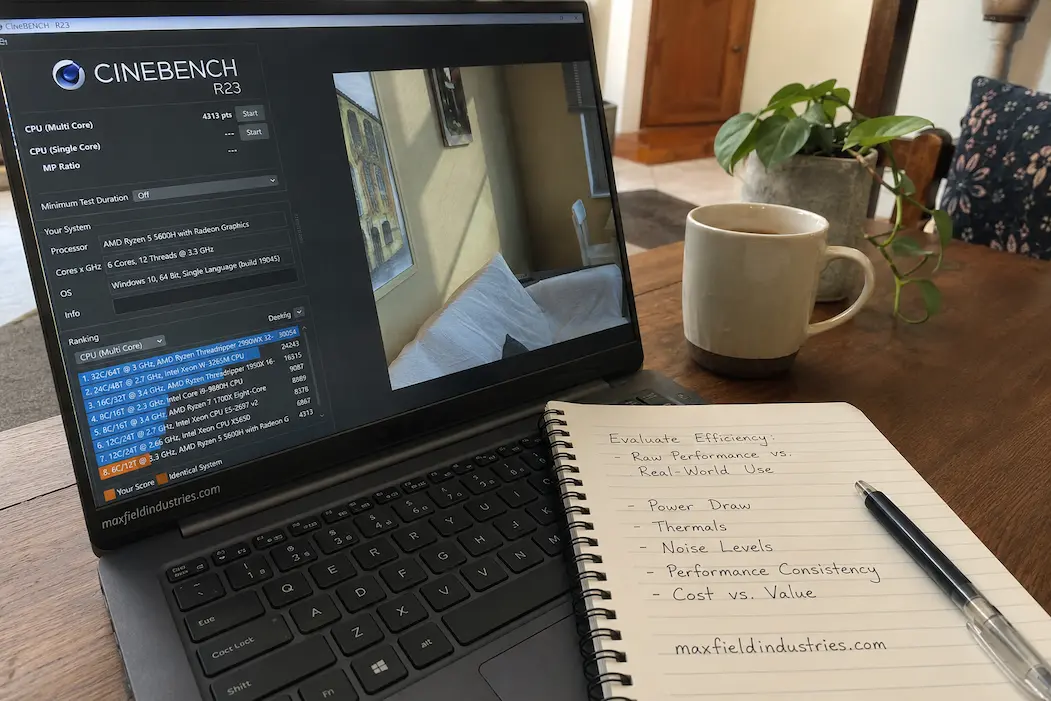
More Performance Does Not Always Mean Better Computing
Performance metrics are often used to describe computer hardware. Memory is rated by speed, storage devices by transfer rates, graphics cards by rendering output, and processors by processing power. These figures are useful because they demonstrate hardware performance in specific scenarios. However, they address only a small part of a larger question: how can existing resources be used effectively to produce valuable work?
Efficiency, in the context of hardware, requires a different approach. It focuses on how performance can be achieved intelligently during everyday use, rather than on the peak performance a system might reach under extreme conditions. Even if two computers take roughly the same amount of time to complete the same task, one might use fewer resources, generate less heat, run more stably, and remain reliable for longer. Raw performance figures do not fully reflect the real-world differences between these systems.
Understanding this distinction helps explain why professional system designers, engineers, and business managers often evaluate efficiency alongside speed. Often, balanced resource utilization and sustainable performance are more beneficial than occasional bursts of peak productivity.
Efficiency Reflects the Relationship Between Resources and Results
Every computer relies on a finite set of resources. Delivering effective results depends on many factors, including processing power, power consumption, cooling capacity, memory bandwidth, storage throughput, and communication channels. The extent to which these resources translate into effective results—rather than unnecessary overhead—is known as hardware efficiency.
Consider two workstations working on the same engineering project. One workstation operates at a lower temperature, with quieter cooling and more stable responsiveness, while the other completes the same task before the deadline. Although the final performance appears identical, the second workstation is more efficient because it achieves the same goal while placing less strain on the surrounding hardware.
This concept extends beyond professional workstations; efficient resource use also benefits everyday computers. Since hardware does not need to expend energy adapting to unnecessary constraints, efficient operation typically results in smoother multitasking, more predictable responsiveness, and greater stability.
When viewed more broadly, efficiency shows that performance depends on balancing the use of available resources to accomplish meaningful work, rather than simply producing a higher volume of work.
Maximum Capability Represents Only One Operating Condition
Hardware advertisements often highlight peak performance because it allows for a clear comparison between different products. For instance, storage devices advertise exceptionally high transfer speeds during sustained, continuous processing, while CPUs reach specific operating frequencies under heavy load. Although these figures are theoretically accurate, they reflect performance under carefully controlled conditions rather than day-to-day operational stability.
Most computers do not run at full load for extended periods. The demands of office applications, development environments, educational software, research platforms, and creative workflows vary throughout the day. Hardware continuously adjusts its operational state based on the requirements of the active program as these demands shift.
Efficiency is particularly important under these typical operating conditions, as it influences a computer’s ability to adapt to fluctuating workloads. Systems that effectively adjust to varying activity levels generally provide a better long-term user experience than those designed primarily for brief bursts of peak performance.
Therefore, evaluating hardware solely based on maximum output does not provide an accurate picture of performance in real-world applications.
Sustainable Performance Often Matters More Than Peak Output
Computers often complete a small number of tasks in a long timeframe. Since many specialized tasks require long execution times, hardware must be capable of delivering stable performance over extended periods rather than exceptional performance during brief spikes.
Multimedia production, scientific computing, software compilation, engineering analysis, and large-scale data management often take hours to complete. Under certain workloads, interruptions, changes in the operating environment, or gradual performance degradation can have a greater impact on productivity than initial processing speed, making stability crucial.
The ability of efficient hardware to maintain stable performance over these long durations is often a key attribute. A balanced system distributes the workload to enable continuous operation without overloading nearby components, rather than consuming all available resources at once.
This characteristic explains why engineers often distinguish between sustained performance and peak performance. While both metrics are useful, long-term efficiency generally contributes more to the reliability of day-to-day computing tasks.
Hardware Efficiency Beyond Individual Components
Efficiency assessment becomes particularly important when a computer is viewed as a holistic platform rather than a collection of separate devices. Each element affects the others, influencing their operating conditions and, ultimately, overall efficiency.
For example, the cooling system affects the reliability of components in maintaining their intended operating characteristics, while the processor relies on rapid access to memory and storage. Similarly, the coordination of available resources under realistic workloads depends on firmware, the power supply, and system architecture.
Simply improving a single specification does not always lead to higher overall efficiency, as these interactions are continuous. A system comprising high-performance components and weaker supporting hardware typically operates less smoothly than a balanced platform where all components work together effectively.
As this system-oriented approach suggests, efficiency assessment should be conducted at the platform level rather than by examining individual specifications.
Resource Usage Reflects Hardware Performance
Completed workloads can be described using raw performance metrics, but the efficiency with which available hardware contributes to task completion is not always immediately apparent. Resource usage offers a new perspective by analyzing whether system components work together in a balanced manner.
A well-designed computer can typically allocate tasks based on the workload. When calculations are required, processing resources remain active; storage ensures efficient data handling; memory enables rapid access to active data; and communication between components proceeds smoothly. When these interactions are balanced, the system can often handle a variety of tasks effectively. On the other hand, if one resource is heavily utilized while others face prolonged idle periods, this may indicate an opportunity to improve coordination. The goal is to ensure that available resources are effectively deployed for productive work—rather than causing unnecessary delays—rather than simply striving for maximum resource utilization.
Therefore, examining hardware from the perspective of resource usage can yield crucial insights into efficiency improvements that cannot be fully explained by raw performance data alone.
Comparing Performance and Efficiency Together
Looking at both performance and efficiency provides a more complete understanding of hardware behavior.
| Evaluation Perspective | Primary Question Answered |
|---|---|
| Raw performance | How much work can the hardware complete under specified conditions? |
| Hardware efficiency | How effectively are available resources converted into useful work? |
| Sustained operation | Can performance remain consistent during extended workloads? |
| Resource utilization | Are different hardware components contributing in a balanced manner? |
| Platform behavior | Does the complete system operate smoothly across changing workloads? |
Considering these perspectives together helps explain why two computers delivering similar levels of performance may produce noticeably different experiences during long-term everyday use.
Efficiency Becomes More Visible During Extended Use
Short demonstrations often highlight how quickly hardware can complete a demanding task, but efficiency tends to reveal itself over much longer periods of operation. A computer that performs well during the first few minutes of testing may behave differently after supporting continuous workloads throughout an entire workday. Components warm up, background processes become active, storage activity changes, and multiple applications begin competing for system resources.
Under these conditions, efficiency is reflected in the computer’s ability to maintain predictable behavior instead of chasing occasional bursts of exceptional performance. Users generally notice this through stable responsiveness, consistent application behavior, and fewer interruptions during prolonged work sessions. Rather than drawing attention to itself with impressive peak figures, an efficient system quietly continues supporting productive work without frequent fluctuations.
This long-term perspective explains why organizations responsible for engineering, education, research, and business operations often evaluate hardware over realistic usage periods instead of relying solely on brief performance demonstrations.
Workload Characteristics Influence the Value of Efficiency
Not every computing task rewards maximum hardware capability in the same way. Some workloads consist of short bursts of activity followed by long periods of relatively light operation, while others maintain continuous demand for hours without significant interruption. These differences influence whether efficiency or peak performance contributes more to the overall experience.
For example, office productivity, software development, research, and web-based collaboration frequently involve changing patterns of interaction where applications open, close, exchange information, and remain active simultaneously. In these environments, smooth resource management often contributes more to productivity than hardware capable of reaching exceptionally high operating levels for brief moments.
Conversely, specialized computational tasks may legitimately benefit from higher peak capability because they spend much of their execution time performing sustained calculations. Even then, efficiency remains important because maintaining consistent output throughout the workload is often more valuable than achieving an impressive initial result followed by reduced performance later.
Understanding the relationship between workload characteristics and efficiency allows hardware to be evaluated according to practical requirements instead of assuming every task benefits equally from the same design priorities.
Efficient Hardware Often Supports Better System Stability
Performance and stability are frequently discussed as separate characteristics, yet they influence one another throughout the lifetime of a computer. Hardware operating within balanced conditions generally experiences fewer abrupt changes in operating behavior, allowing the entire platform to function more predictably during demanding workloads.
Stable operation is particularly valuable when computers remain active for extended periods. Long-running projects, development environments, research platforms, virtualization, and professional content creation all benefit from systems capable of sustaining dependable operation without excessive fluctuations. In these situations, efficiency contributes indirectly by reducing unnecessary strain on supporting resources and allowing the platform to maintain balanced operating conditions.
This relationship explains why experienced system designers rarely pursue raw performance in isolation. Hardware that consistently performs within well-managed operating conditions often proves more dependable than systems designed primarily around achieving the highest possible specification regardless of long-term behavior.
Efficiency Should Be Evaluated Across the Entire Platform
Computers are sometimes evaluated as collections of independent components, with each specification examined separately before concluding the overall system. Practical experience shows that efficiency rarely emerges from isolated excellence. Instead, it develops through cooperation between processing resources, memory, storage, cooling, firmware, power delivery, and software working toward the same objective.
A processor capable of completing demanding calculations rapidly still depends on timely access to data. Storage hardware contributes little if surrounding resources cannot utilize information efficiently. Likewise, sophisticated cooling solutions provide value only when they help maintain consistent operating conditions throughout the platform. Each subsystem influences the efficiency of the others because meaningful work depends on continuous interaction rather than isolated capability.
Viewing efficiency at the platform level encourages more balanced evaluation. Rather than identifying one exceptionally strong component, attention shifts toward understanding how effectively every part contributes to the complete computing experience.
Practical Evaluation Requires More Than One Measurement
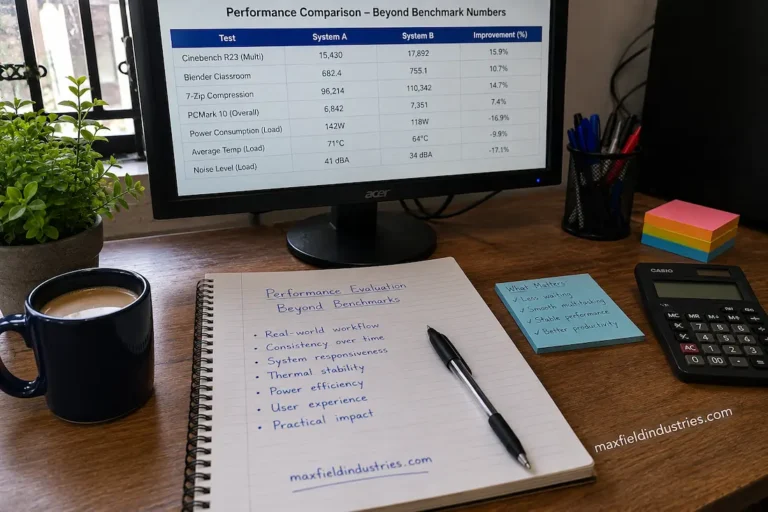
No single performance figure can fully describe hardware efficiency because efficiency reflects several characteristics working together. Engineers therefore evaluate systems from multiple perspectives before forming conclusions about overall behavior.
| Evaluation Area | Why It Matters |
|---|---|
| Resource utilization | Indicates how effectively available hardware contributes to useful work rather than remaining unnecessarily idle or overloaded. |
| Sustained consistency | Shows whether performance remains dependable throughout prolonged workloads instead of declining after short periods. |
| Thermal behavior | Helps explain how operating conditions influence long-term reliability and performance stability. |
| Platform balance | Reveals whether different hardware components cooperate efficiently under changing workloads. |
| Workflow responsiveness | Demonstrates how comfortably the system supports practical day-to-day computing activities. |
Looking at these characteristics together provides a broader understanding than comparing isolated performance figures. Hardware efficiency is best understood as the quality of the overall operating experience rather than a single numerical result.
Improved Technical Design Often Goes Unnoticed by Users
Highly efficient computer systems are rarely directly noticed by users, even though their efficiency is precisely one of their most attractive qualities. Instead of drawing attention through dazzling speed, they create an environment where applications respond stably, workflows run smoothly, and routine calculations proceed without unnecessary interruptions.
This seemingly simple characteristic is no accident; it is the result of careful design. A system’s ability to function stably under varying workloads stems from intelligent resource coordination, effective thermal management, efficient inter-component communication, and a balanced choice of hardware. Successful design decisions—often imperceptible in daily use—manifest themselves in the system’s consistent, smooth operation.
Therefore, efficiency should not be viewed as a secondary attribute but rather as a priority alongside performance. Efficient operation is a key reason why computers can continue to perform reliably for years across diverse real-world scenarios.
Looking Beyond Maximum Numbers
Since raw performance defines a system’s maximum capacity, it remains a crucial aspect of hardware evaluation. However, meaningful computing goes beyond these limits to encompass more typical scenarios, such as the need for prudent long-term resource management, fluctuating workloads, and application interactions. Beyond performance, evaluating efficiency provides a deeper understanding of hardware quality. This encompasses more than just the workload a computer can handle under optimal conditions; it also includes operational reliability, the efficiency of resource interaction, and the platform’s ability to manage everyday tasks. This broader perspective brings hardware evaluation closer to real-world applications, allowing technology choices to be based on long-term utility rather than solely on individual performance improvements.
FAQs
1. What is the difference between raw performance and hardware efficiency?
Hardware efficiency assesses how effectively available resources are used during actual operation, whereas raw performance analyzes the workload the hardware can complete under specific conditions.
2. Can two computers perform the same task but differ in efficiency?
Even with the same workload over the same period, systems can differ in resource usage, stability, thermal performance, and overall platform balance.
3. Why is productivity crucial for demanding workloads?
Sustained workloads best demonstrate hardware performance stability. When operating conditions change, efficient systems typically maintain more stable operation.
4. Is the peak performance of efficient hardware always lower?
Not necessarily. High-performance hardware can also be highly efficient when it operates stably under realistic workloads and utilizes available resources intelligently.